Published by Joe Webster
Last updated Mar, 19 2026
Moving across state lines is one of the most significant decisions many Americans make, involving high costs, complex logistics, and essential lifestyle changes. Each year, millions of households, military families, and corporate employees relocate long distances, reflecting broader trends in migration, housing, and the economy.
This dataset compiles the latest statistics on how many people are moving, how far they go, what it costs, and what challenges they face. Drawing insights from U.S. Census data, the Department of Transportation, and significant studies in the moving industry, the following sections highlight the key facts and figures that shape long-distance moving in 2025–2026.
How Many Americans Move Long-Distance?
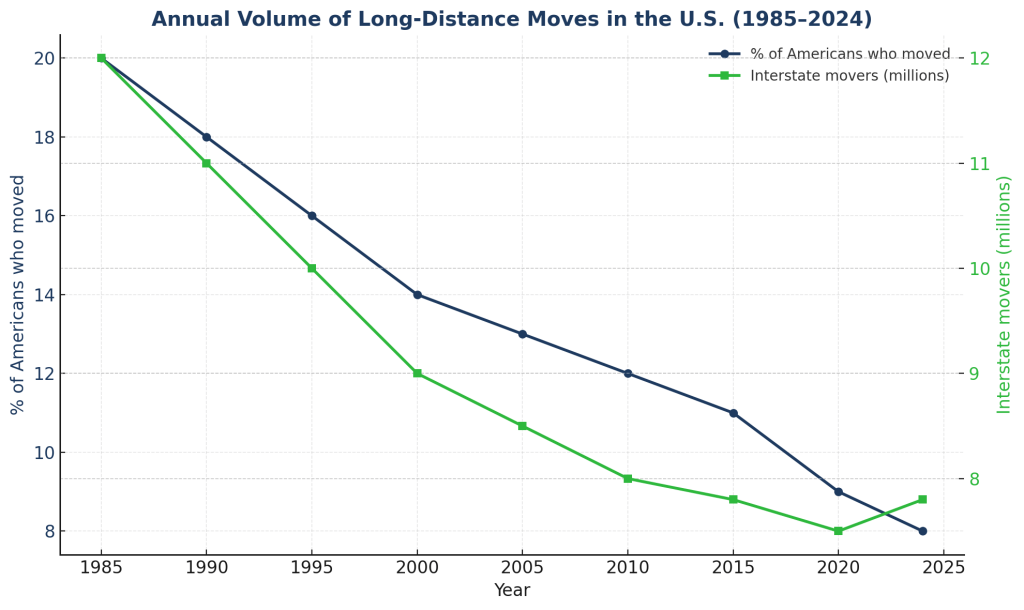
While fewer people are moving overall compared to decades past, millions still relocate to another state every year.
- About 25–28 million Americans move annually, or just 8% of the population — the lowest rate in U.S. history (U.S. Census Bureau).
- Of these, 7.5–8.2 million make interstate moves, roughly 20% of all moves (ACS migration tables).
- The Department of Defense adds another 300,000–400,000 military relocations each year.
- Top reasons: housing (40%), jobs (20%), family (25%) (Census ACS).
Who Moves Long-Distance: Households, Military & Corporate
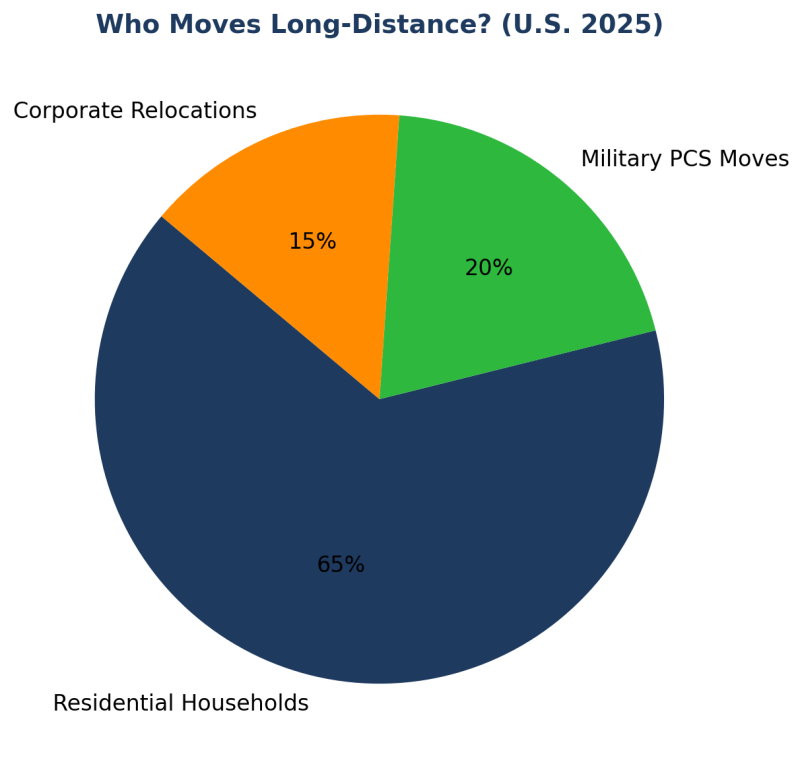
Different groups account for long-distance moves, each with unique patterns.
- Military PCS moves: ~15–20% of all interstate moves annually (DoD).
- Corporate relocations: average ~1,200 miles per move, often full-service (Atlas Van Lines).
- Residential households: the largest share, driven by affordability and lifestyle.
Average Costs of Long-Distance Moves
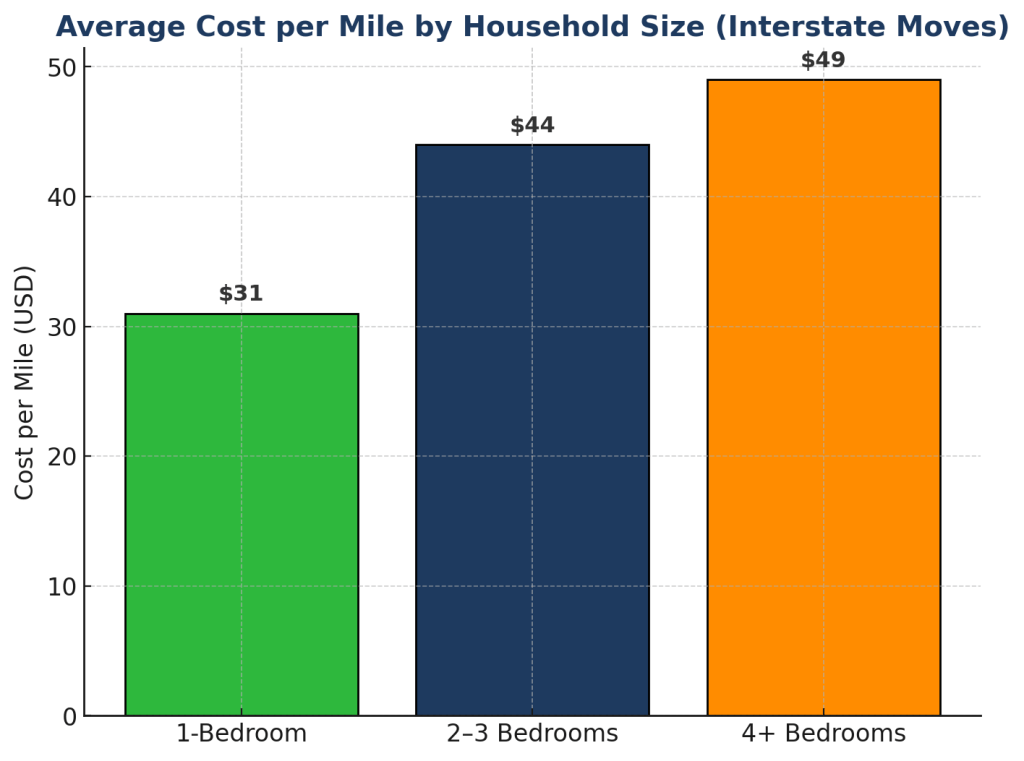
Costs vary by distance and household size but are generally rising.
- $8,100 average interstate move in 2022 (AMSA/ATA).
- Cost per mile: $31 (1-bed), $44 (2–3 bed), $49 (4+ bed) (AMSA/ATA).
- Cross-country (2,500+ miles): $8,000–$12,000 (United Van Lines).
Distance Bands & Price Examples
Costs increase predictably with distance.
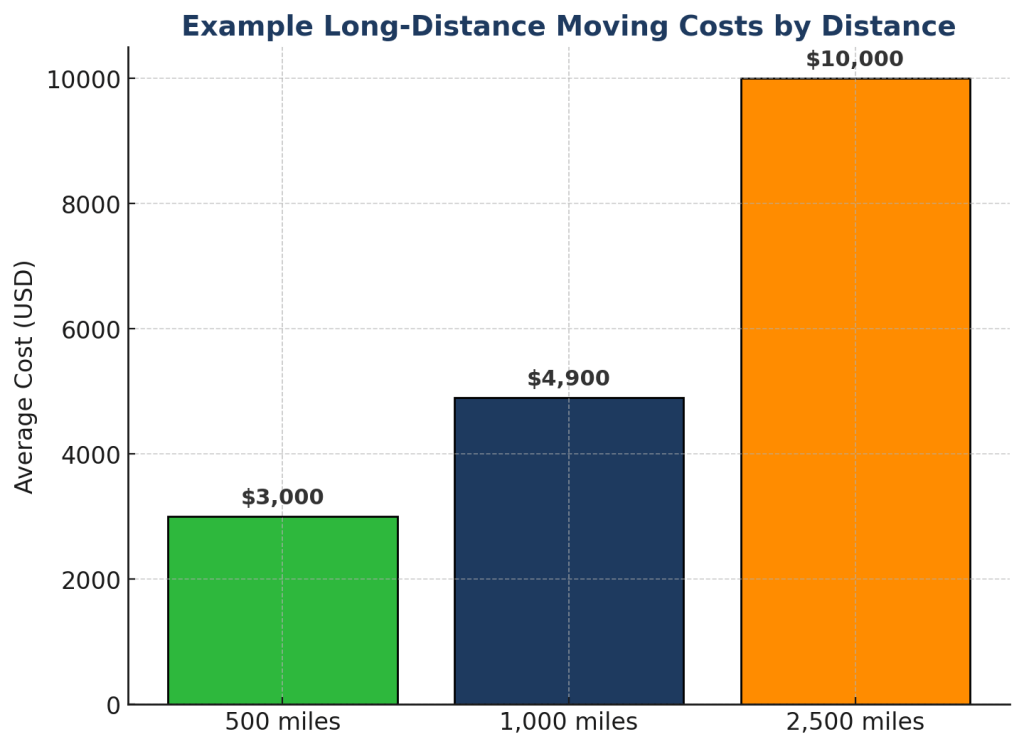
- 500 miles: ~$2,500–$4,000 for a small apartment.
- 1,000 miles: ~$4,900 for 7,400 lbs (Allied Van Lines).
- 2,500 miles: ~$10,000+ for a family home.
Cost Drivers & Surcharges
Several factors affect final moving bills.
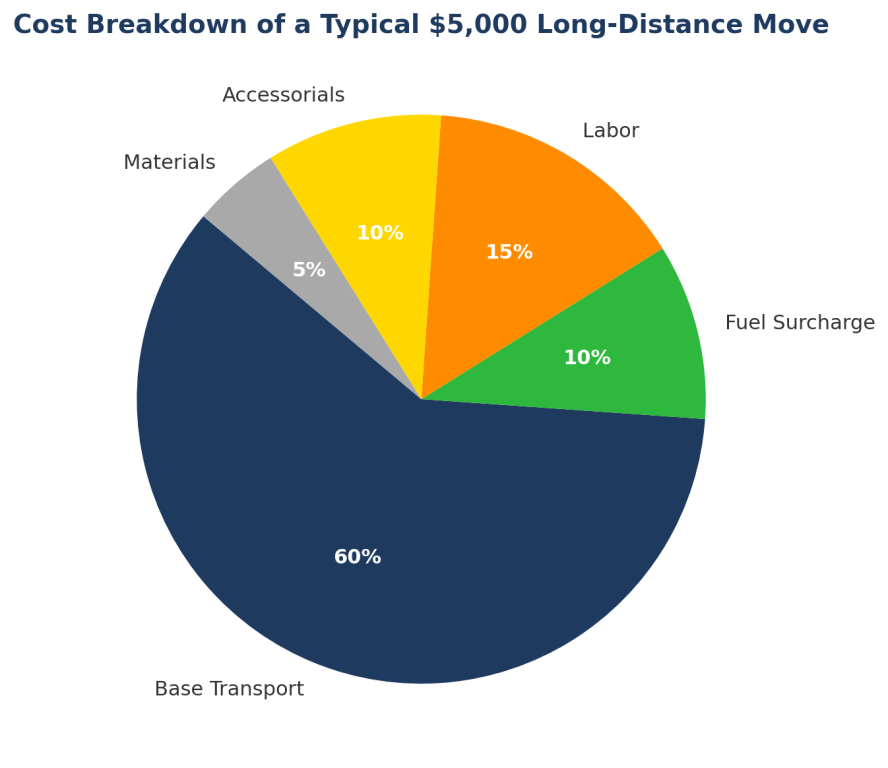
- Fuel surcharges: 5–15% of costs, peaking at 24% in 2022 (EIA).
- Seasonality: summer moves cost 20–30% more.
- Accessorials: stairs ($50–$150), long carry ($75+), shuttle fees ($300+).
- Labor & materials: mover wages +20% since 2020; packing supplies +35%.
Transit Times & Delivery Windows
Delivery can take days to weeks, depending on distance and service.
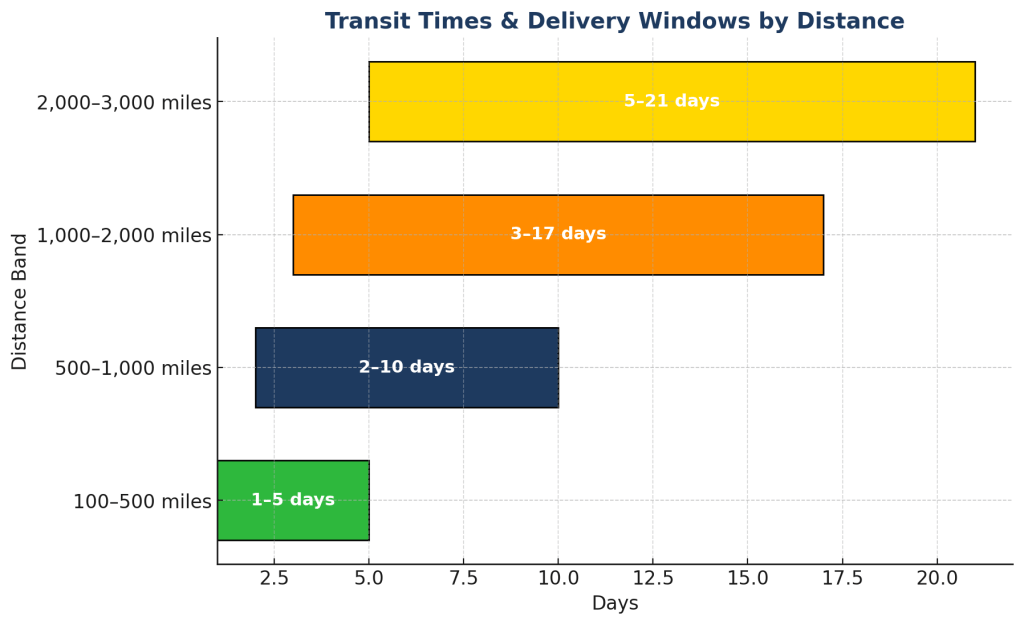
- 100–500 miles: 1–5 days.
- 500–1,000 miles: 2–10 days.
- 2,000–3,000 miles: 5–21 days (USDOT).
- Average long-distance move: 10–14 days.
Popular Long-Distance Routes
Migration trends create busy interstate lanes.
- California → Texas and New York → Florida are top flows (Census ACS).
- CA → AZ/NV and NY → NJ common regional moves.
- High inbound states: Texas, Florida, North Carolina.
- High outbound states: California, New York, Illinois.
Related Article: Home Depot POD Rental Prices: What You’ll Really Pay in 2026
Typical Move Weights & Distances
Shipment size and distance define most moves.
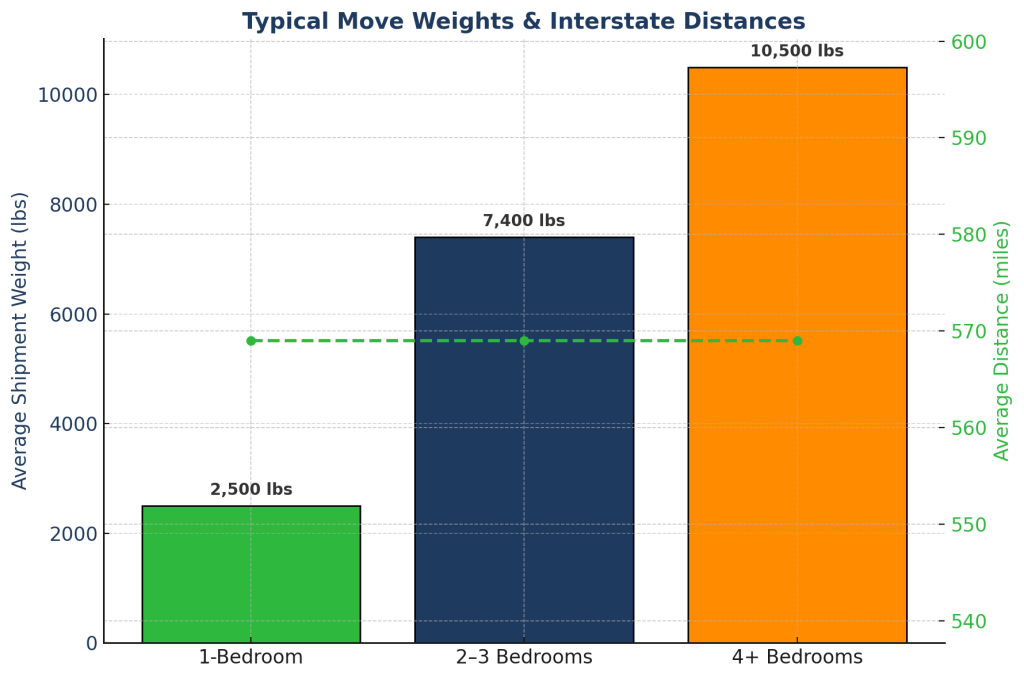
- Average interstate shipment: ~7,400 lbs (Allied Van Lines).
- Typical distance: ~569 miles (HireAHelper migration report).
- Weights by home size:
- 1-bed: 2,000–3,000 lbs
- 2–3 bed: 5,000–8,000 lbs
- 4+ bed: 9,000–12,000 lbs
Customer Complaints & Claims
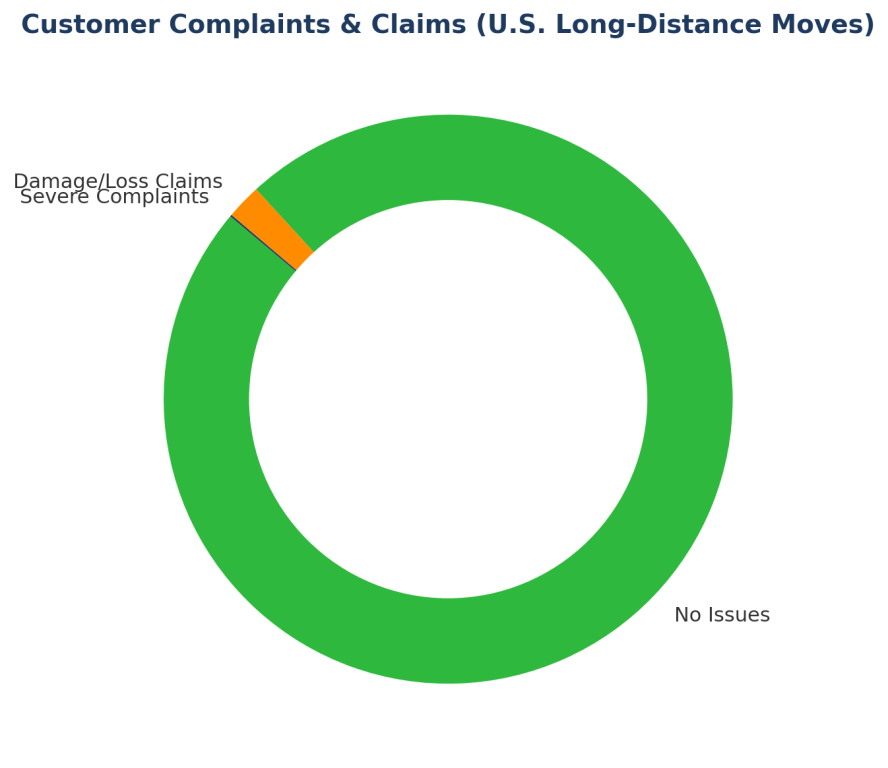
Most moves go well, but issues do occur.
- 8,769 complaints in 2023 to USDOT, 1 per ~4,000 moves (FMCSA).
- 20% of moves report minor damage claims (FMCSA/BBB).
- High-quality movers report <2% claim rates.
- Peak-season delays and overcharging are top complaint types.
Future Outlook for 2026
The industry faces both challenges and opportunities.
- Demand: slight rebound as housing market stabilizes (ATA/NAHB).
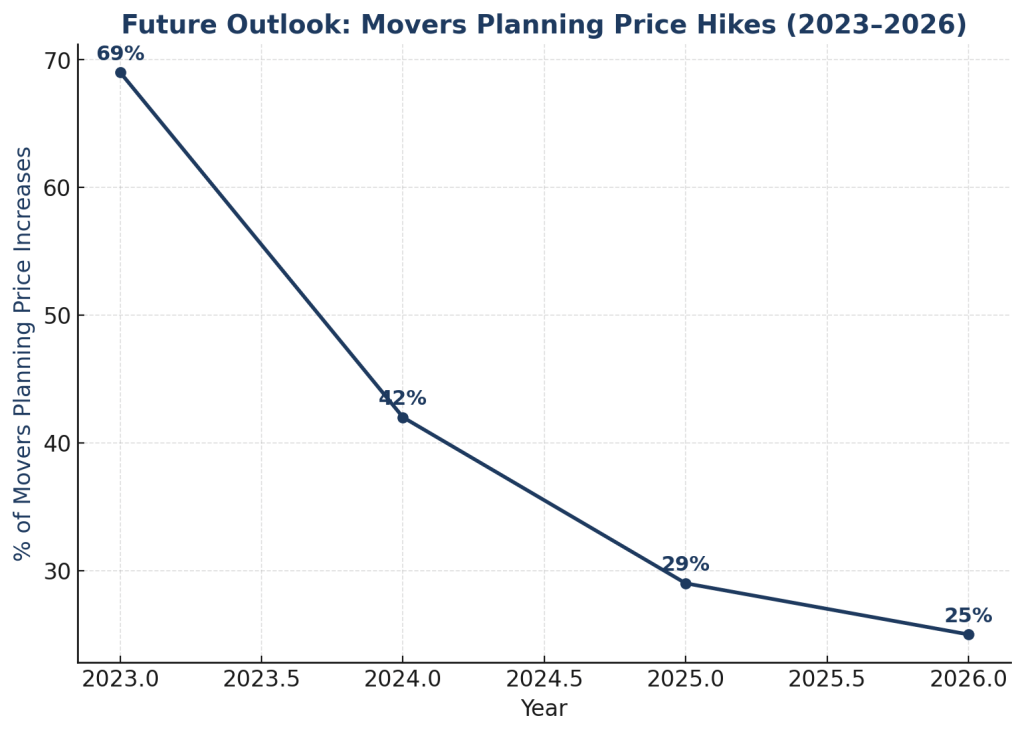
- Pricing: only 29% of movers plan increases in 2025 vs. 69% in 2023.
- Labor: U.S. short 60,000–80,000 truck drivers; could hit 100,000+ by 2026 (ATA).
- Adaptation: 40% of movers prioritizing efficiency via tech and logistics.
Wrap up
Long-distance moving reflects America’s shifting demographics and economic pressures. Millions still make the leap each year, often at high cost and stress. For families, military personnel, or businesses, understanding these trends can help in planning and budgeting.
Three Movers provides reliable, transparent, and affordable long-distance moving solutions nationwide. Whether you’re relocating for work, family, or a fresh start, our team ensures your move is handled with care and professionalism.
Get a Free Quote for Long-Distance Moving Services
Frequently Asked Questions
Recent long distance moving statistics show continued outbound movement from high-cost metros and steady inbound growth in the Southeast, Mountain West, and parts of Texas. Moves are most common among adults ages 25–44 and typically span 300–1,500 miles. Trends are shaped by housing affordability, remote-work flexibility, job markets, and seasonal weather patterns affecting transit times. Long-distance relocations are regulated under interstate rules, which influence timing and delivery. For planning guidance, see our long distance moving service.
Recent moving statistics by state show strong inbound migration to Florida, Texas, North Carolina, Tennessee, and South Carolina, driven by job growth and lower living costs. Outbound migration remains high from California, New York, Illinois, and New Jersey. These patterns affect carrier capacity, freight routing, and delivery windows for interstate shipments. Distance, season, weather, and local permit rules also influence when movers can load and unload.
The long distance moving industry generates billions annually and serves over 3 million interstate moves per year, according to recent national estimates. Demand is influenced by employment mobility, housing availability, population shifts, and seasonal peaks (May–September). Carriers must meet FMCSA requirements, track shipment weight, and manage travel logistics such as fuel costs, layovers, and state-to-state regulations. These factors shape pricing frameworks and delivery timelines.
Early 2025 indicators suggest continued high inbound demand for Florida, Texas, Tennessee, North Carolina, and Arizona. These states consistently show net-positive migration due to cost-of-living advantages and strong job growth. Long-distance carriers adjust routing and fleet availability to these corridors, which can shorten delivery windows. Weather, housing turnover cycles, and regional road networks also influence arrival scheduling.
Major drivers include housing affordability, expanding remote-work flexibility, retirement migration, climate preferences, and tax considerations. Moves often involve 1–4 movers depending on home size and may require multi-day loading for large homes, long-carry access, or bulky specialty items. Interstate rules, seasonal demand, and route congestion also shape delivery windows. Our state-to-state moving company page explains typical transit planning.
Costs have stabilized after earlier spikes in fuel, labor, and equipment, but long distance moves still vary widely. A typical household shipment may fall between $3,000–$9,000 depending on weight, mileage, packing needs, access conditions, and seasonal traffic. Interstate transport time generally ranges 5–14 days. Weather delays, multi-stop routes, and building restrictions can extend schedules. For budget planning, see our moving cost estimator.
Adults 25–44 remain the largest long-distance moving group, driven by career changes, remote-work shifts, and housing transitions. Retirees also make up a notable share, often relocating to warmer, lower-tax states. These demographic patterns influence shipping volumes, peak-season congestion, and equipment distribution across regions. Crew size, packing needs, and transit timing vary significantly by household size.
Many long distance moves fall in the 500–1,200 mile range, though cross-country shipments can exceed 2,000 miles. Longer routes add fuel, labor hours, overnight stops, and weigh-station compliance. Delivery windows expand with distance, seasonal weather, and congested metro corridors. Narrow streets, HOA restrictions, or limited parking can require shuttle trucks at destination. For planning multi-day routes, our moving estimate tool offers a starting framework.